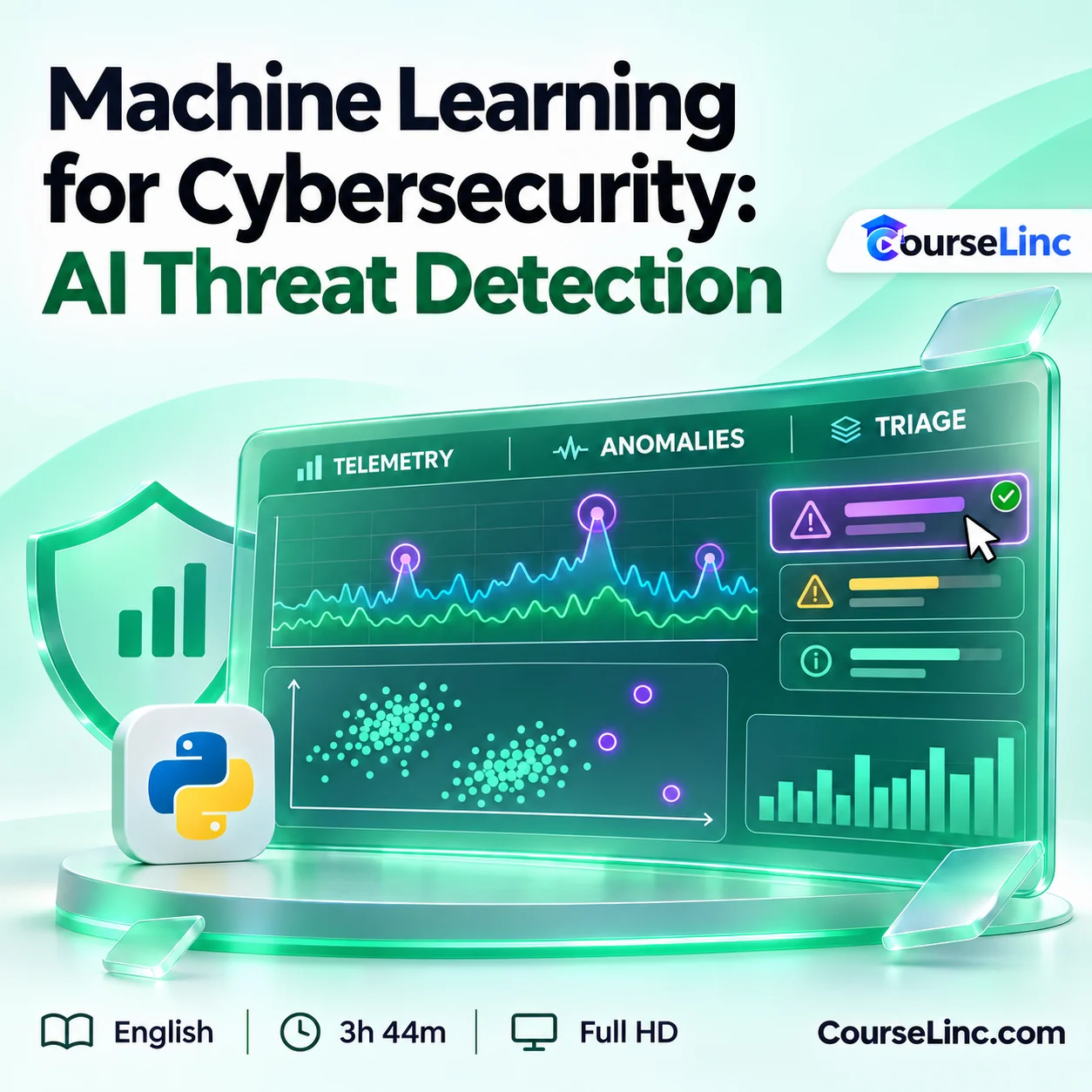


Machine Learning for Cybersecurity: AI Threat Detection
Explore AI Threat Detection through a local Python pipeline with Isolation Forest, Random Forest, risk explanations, FastAPI, a Streamlit SOC dashboard and 41 pytest tests.
3h 44m • English • Full HD
This course contains the use of artificial intelligence.
Course Overview
Machine Learning for Cybersecurity: AI Threat Detection
Connect telemetry, models and defensive triage.
Explore AI Threat Detection through a hands-on local Python and scikit-learn project for defensive threat detection and intrusion detection. The course brings reproducible host and network logs together with machine-learning models, risk explanations, an API and a SOC dashboard.
Follow a production-oriented educational pipeline from feature preparation to severity triage, integrity checks and tests. The project combines anomaly detection with classification of the attack categories covered in the lessons.
This course contains the use of artificial intelligence.
AI Threat Detection: 6 connected pipeline areas
Connect data preparation, model outputs and operational presentation through the course project.
Prepare reproducible telemetry
Work with reproducible host and network logs using six features: CPU, Memory, NetworkBytes, Logins, FileWrites and Connections. Connect these inputs with the pipeline used by the models.
Detect anomalies with Isolation Forest
Explore a 200-tree Isolation Forest trained only on benign data for identifying unseen anomalies. Fit StandardScaler on training data only as part of the preparation workflow.
Classify the covered attack categories
Train and evaluate a 300-tree Random Forest on labeled brute-force, cryptomining, exfiltration and mass-file-modification categories. Relate classification outputs to the defensive events represented in the project.
Turn model outputs into risk explanations
Combine anomaly scores and attack probabilities through a deterministic 3×3 risk matrix with LOW, MEDIUM, HIGH and CRITICAL severity labels. Connect results with explanations for triage.
Expose results through an API and dashboard
Work with FastAPI, Pydantic and the /predict and /health endpoints. Explore a Streamlit SOC dashboard with live KPIs, severity filters and triage to present the pipeline results.
Check integrity and test the pipeline
Explore SHA-256 hash checks for serialized model files and 41 pytest tests using real models and golden attack fixtures. Bring integrity checking and repeatable tests into the educational pipeline.
Explore the course details
How the pipeline fits together
The AI Threat Detection project connects reproducible telemetry, training-only scaling, benign-data anomaly training and attack-category classification. The six named features form the shared input vocabulary across the course workflow.
The production-oriented educational design brings model outputs into a deterministic risk matrix, then presents them through an API and a Streamlit SOC interface. The focus remains on a local defensive project, with severity triage and explanations alongside integrity checks and test coverage.
Course tests and reported golden benchmark
The AI Threat Detection course reports 41 pytest tests using real models and golden attack fixtures. The course project reports a telemetry streaming cadence of 23 ms per event. Its golden attack benchmark reports 100% detection and 0% false alarms.
The streaming figure describes cadence within the course project. The accuracy figures are course-reported results scoped to the golden attack benchmark and its fixtures. These educational results do not establish universal detection accuracy, false-alarm rates or deployment performance.
Starting point, audience and course format
Basic Python is required; no previous machine-learning or cybersecurity experience is needed. Use a standard Windows, Mac or Linux computer. The course is relevant to SOC and cybersecurity professionals, ML and data-science learners, Python software practitioners, and DevSecOps or cloud teams.
- Duration and language
- 3 hours 44 minutes / English
- Video
- MP4 / H.264, 1920 x 1080
- Audio
- AAC, 44.1 kHz, 2 channels
This course contains the use of artificial intelligence.
Explore related IT & Software courses or browse Development courses on CourseLinc. For product reference, see the official scikit-learn guidance and Isolation Forest reference.