
Calibrating Operational Constraints for AI Workloads at Cloud Scale
Explore AI Workloads through telemetry baselines, cost and quality constraints, failure signals, breach responses, scoped permissions and controlled boundary validation.
56m 42s • Advanced • English with subtitles • Full HD
Course Overview
Calibrating Operational Constraints for AI Workloads at Cloud Scale
Calibrate limits around the workload you actually observe.
Explore AI Workloads through cost, quality and permission constraints grounded in observed behavior. Learn to establish a workload-specific baseline, interpret failure signals and choose responses when a boundary is breached.
AI behavior can vary in ways that limits copied from predictable services do not capture. The course examines how those limits can produce unnecessary paging alerts or miss runaway agents, then develops an approach to calibration and validation.
AI Workloads: 6 connected calibration areas
Study the decisions involved in setting limits, interpreting breaches and checking whether the whole constraint set behaves as intended.
Establish a workload-specific baseline
Use cost, latency and invocation telemetry to establish the workload's own baseline. Examine observed behavior before calibrating the constraints that will guide operational decisions.
Interpret failure signals
Examine signal ordering for retry storms, agent loops, context growth and quality drift. Relate the patterns to observations from the workload and its baseline.
Balance threshold tradeoffs
Explore how tighter thresholds can provide earlier warning while generating more false alarms. Consider the tradeoff when deciding how sensitive a constraint should be.
Choose a response to each breach
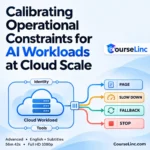
Decide whether a breach calls for paging someone, slowing down, using a fallback or stopping. Relate the response choice to the constraint and behavior being examined.
Scope identities and tool permissions
Examine identity and tool permissions as operational boundaries. Scope the allowed actions to contain a mistake, then consider how those boundaries can be checked.
Validate the constraint set
Check AI Workloads against ordinary days and known failure patterns. Use controlled expected-refusal checks to verify boundaries, and evaluate the whole set of constraints together.
Explore the course details
From observed telemetry to operational responses
The AI Workloads workflow starts with the behavior of the workload itself. Cost, latency and invocation telemetry provide a baseline for considering cost, quality and permission constraints.
Signal ordering is examined across retry storms, agent loops, context growth and quality drift. Threshold choices and breach responses are considered alongside the behavior observed in the workload.
Boundary checks and whole-set validation
AI Workloads are evaluated through the whole constraint set, using ordinary days and known failure patterns. This brings the constraints, the alerting tradeoff and the response decisions into the same review.
Controlled expected-refusal checks verify whether identity and tool-permission boundaries hold when an action should be refused. The course treats boundary checks and workload-pattern validation as parts of the calibration process.
Course format
- Duration and level
- 56 minutes 42 seconds / Advanced
- Language
- English, with subtitles available
- Video
- MP4 / H.264, 1920 x 1080
- Audio
- AAC, 44.1 kHz, 2 channels
Explore related IT & Software courses or browse Development courses on CourseLinc. For optional alerting background, see the Google SRE alerting guide.